Consecration of Sri Vijaya Durga Devi Temple
The construction of the Sri Vijaya Durga temple was undertaken following the guidance of the architect Smt. Lakshmikantamma, a resident of Proddatur, on a worthy, auspicious site facing east on the western side of the city. The foundation stone was laid by Sri C. V. Subbanna, a Satavadhani, and the work proceeded under the supervision of Srimaan Vellala Venkata Seshayya — a centenarian elder rich in Vedic knowledge and a resident of Tallamapuram. From Magha Shuddha Trayodashi to Bahula Vidiya of the Vrisha year of the Chandramana calendar — that is, on 1-3-2002 — the consecration of the temple spire (shikhara) was performed at 10 in the morning, and the grand consecration festival (Pratishtha Mahotsavam) of Sri Sri Sri Vijaya Durga Amma was celebrated as a feast for the eyes at 1 in the afternoon. From that day to this, the temple has remained radiant, ever-festive and continually astir with devotees. Not only ordinary devotees, but also swamis, heads of monasteries, heads of peethas, and religious leaders come to have darshan of Amma.
Darshan at Sri Vijaya Durga Devi Temple
Sloka: Salutations to you, O refuge of all, O auspicious one, O compassionate one. Salutations to you who pervades the universe, whose form is the cosmos. Salutations to you whose lotus feet are worshipped by the world. Salutations to you, O saviour of the world — protect us, O Durga!
The Sri Vijaya Durga Devi Temple. This shrine stands on the western side of Kadapa town, facing east near the bypass on the Kurnool–Chittoor national highway, shining most beautifully.
As the treasure-fold of those who worship her, as the Mother who fulfils every wish, the World-Mother who protects all the worlds has manifested here in the form of Sri Vijaya Durga Devi — radiating rare and boundless glories unmatched by any of the temples built in the Rayalaseema region in recent times.
Without a mother there is no child. The very call "Amma!" is the first call, the root mantra, for all moving and unmoving life. However glorious an incarnate being may be, he too must be born of a mother, must he not?
The Vedas and Puranas declare that this Supreme Power (Parashakti) is the primordial source even of the Trinity — Hari, Hara and Brahma. The Trimurti who cause creation, sustenance and dissolution; all the deathless and birthless gods; this infinite universe made of the five elements; and every living being in creation — all are under the dominion of Amma, the one Mother of the world.
The union of the syllables 'A', 'U' and 'M' is Omkara; that Omkara is the Pranava sound; that Pranava sound is the first mantra born in the form of sound. That very mantra resounded at the very beginning of creation. That sound of Omkara is the form of the Primordial Power (Adi Shakti). And that very form of the Primordial Power is Sri Vijaya Durga Devi. The scriptures, the Puranas, and even the Upanishads explain this truth to us.
Sloka: There is no knowledge equal to Durga, no japa equal to Durga, no worship equal to Durga, and no penance equal to Durga.
There is nothing that surpasses the chanting of Durga's name. There is no worship greater than the worship of Durga. There is no penance greater than the penance performed for Durga. And though one searches, there is in this world no knowledge that surpasses Durga.
In the word 'Durga' the syllables 'Da', 'U', 'Ra', 'Ga' and 'A' resound. The syllable 'Da' stands for the destruction of demons; the 'U'…
It is remarkable enough that, to have darshan of this Kadapa Vijaya Durgamma, devotees come not only from the surrounding localities but from the neighbouring districts; and it is wondrous that devotees come even from Andhra and from places beyond Andhra. Every single day this Vijaya Durgamma shrine teems with crowds of devotees, ever-festive and radiant. Devotees who come for Amma's darshan should first leave their footwear in the footwear-safekeeping room on the southern side adjoining the temple precinct. Leaving footwear here and there outside hinders the cleanliness of the temple. To leave footwear in front of the temple's main gateway (Simhadwaram) is a fault. No fee whatsoever need be paid at the place where the footwear is kept.
A pathway has been neatly arranged with steel railings leading from outside the temple to within. Coming along this path — built to let devotees proceed in orderly fashion — the devotees enter the temple through the most resplendent main gateway (Simhadwaram).
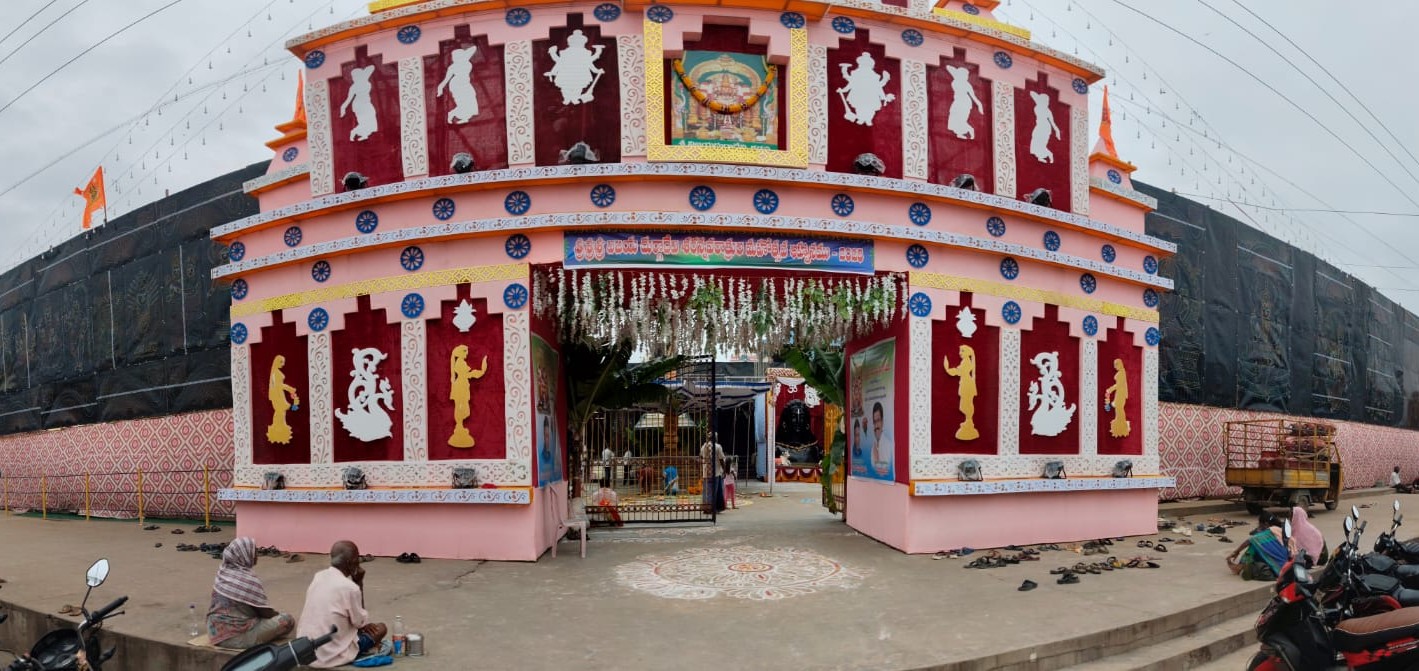
For the devotees who have entered, water taps have been provided nearby on the northern side to wash the feet and face. A devotee who comes into the divine presence first needs purity of body; thereafter, to have darshan of the deity, purity of soul is needed. Everyone who enters the temple should first wash their feet, take a little water in cupped palms, and, remembering Amma, sprinkle it over the head. Then the body is purified, and one gains the fruit of having bathed from head to foot.
Walking a little forward in this way, one beholds the flag-staff (Dhwajasthambham), forty-six feet tall, kissing the sky like a banner of glory proclaiming the renown of Amma's temple. Since Amma is the Mother of this infinite universe, devotees should turn their faces upward, behold the top of the flag-staff, and offer obeisance. To the temple…
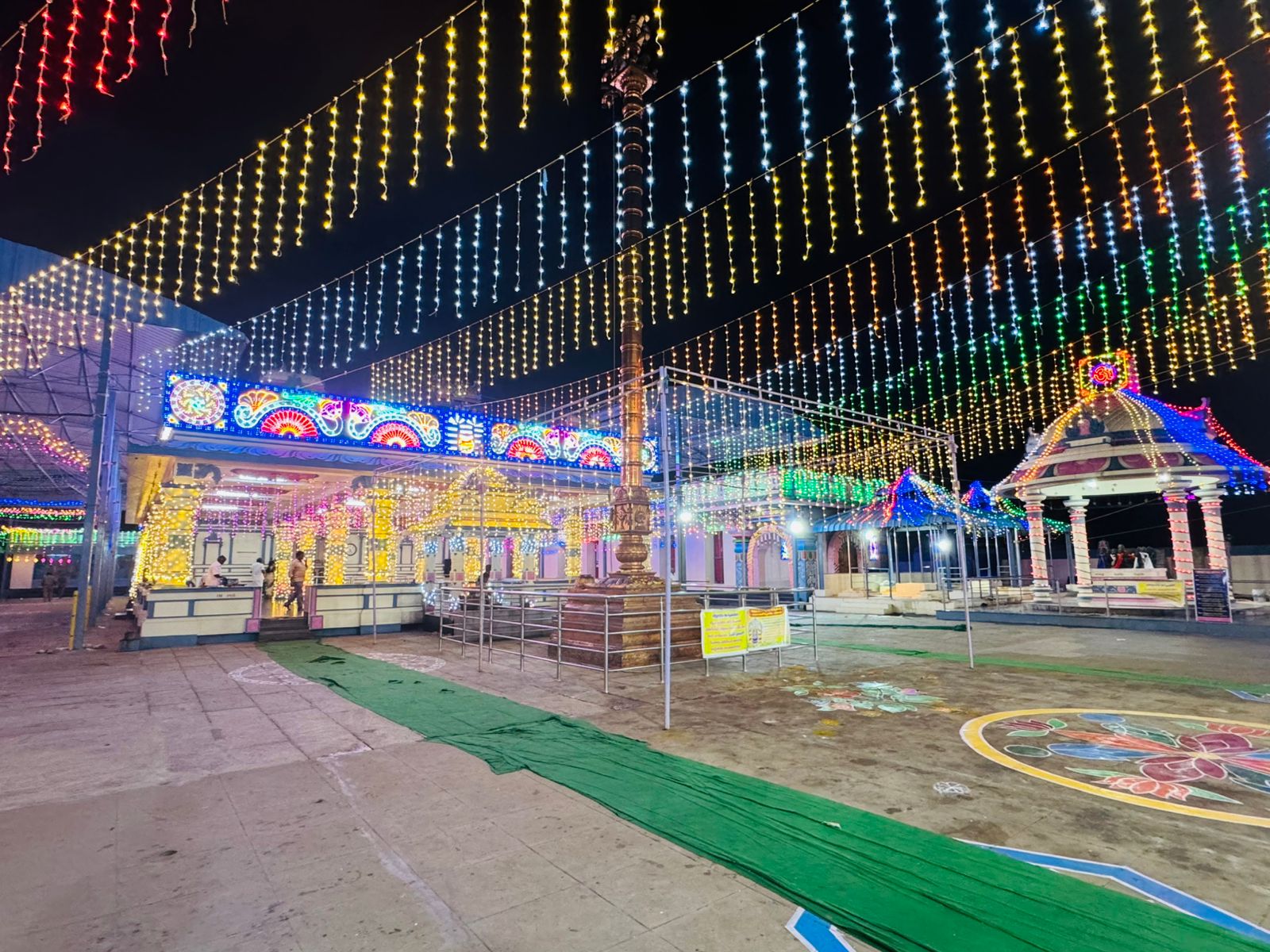
The flag-staff is a symbol. To bow to the flag-staff is to pray to Durgamma: "O Mother, we have come into your sacred presence; keep my mind, my speech and my deeds supremely pure, O Mother!" The elders say that by offering obeisance to the temple's flag-staff and to the vehicle (vahana) of the temple's deity, one gains half the blessing of the deity's darshan.
Moving on from there, one should circumambulate Amma's temple along the broad path on the left side. Circumambulation of the deity is of two kinds: bodily circumambulation (anga pradakshina) and circumambulation of the self (atma pradakshina). Anga pradakshina means walking with palms joined, remembering Amma, completing three, nine, or one hundred and eight circuits. It may also be done by rolling on the ground around the temple without separating the joined hands. This too is called anga pradakshina, and in common speech it is known as 'porlu dandalu' (rolling prostrations).
Atma pradakshina means turning around oneself with folded hands, meditating in the mind upon the form of the Goddess. In the same way, devotees may also perform circumambulation within the temple. Building the temple to allow circumambulation both outside and inside is a hallmark of ancient temple architecture. For the devotees performing circumambulation in this way, a drinking-water tank has been built on the left-hand side inside the great gateway. It has been beautifully shaped like a small pavilion (mandapa). Pure water is available here. It was established through the kind generosity of the 'Sri Jain Sangh'.
Walking from there toward the temple, we come upon the kitchen where Amma's great offerings (mahaprasadams) are prepared. The food-offerings (naivedyam) for Amma's grand offering and the ordinary prasadams for the devotees are prepared continually in this room. Beside it, for the convenience of devotees, there is a stall selling cool drinks and various fruit juices. In front of it, one finds a room selling books and pictures of Amma.
Beside that, a shop selling pooja materials has been built, and next to it, an office room.
Proceeding further, a meditation hall (Dhyana Mandiram) — that is, a long hall — has been built. In a room beside it there is a glass-fronted chamber where the palanquin and other festival paraphernalia are kept. Right next to it, at the rear of the shrine, there is a beautiful east-facing stage. On festival days the festival idols are adorned upon this stage. Moreover, cultural programmes, spiritual discourses, and devotional music concerts are conducted on this stage. This is the stage upon which countless eminent souls, great saints, heads of monasteries and heads of peethas have delivered discourses of divine grace.
Going forward from there toward the north, a prasadam sales hall has been built, along with a kalyana katta where devotees may offer their hair (tonsure). Facing it, on the eastern side, a spacious, long and grand hall (auditorium) has been built in the form of a pavilion. In this hall, on festive occasions, the special adornments of Amma, the celestial wedding festival (Kalyanotsavam), spiritual discourses and cultural programmes are conducted. In front of it, we behold a beautiful sacrificial hall (Yagashala). Here sacrificial rites (yajnas) are performed. Yajnas such as 'Chandi Yagam', 'Varuna Yagam', 'Vishwa Shanti Yajnam' and 'Brahma Yajnam' are conducted. To fulfil their vows and to have their wishes granted, devotees have many kinds of yajnas performed in this sacrificial pavilion under the supervision of the chief priests.
On its eastern side appears a pavilion beautiful in every part. Within it the Nine Planets (Navagraha) have been consecrated. With this, the circumambulation of the temple is complete and we arrive near the main gateway.
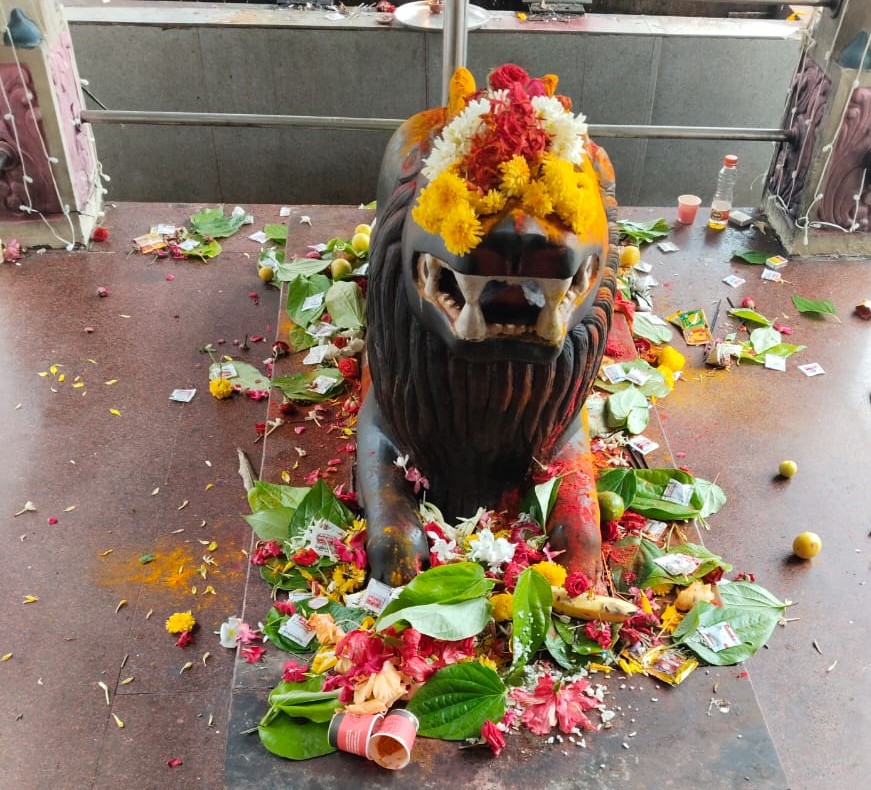
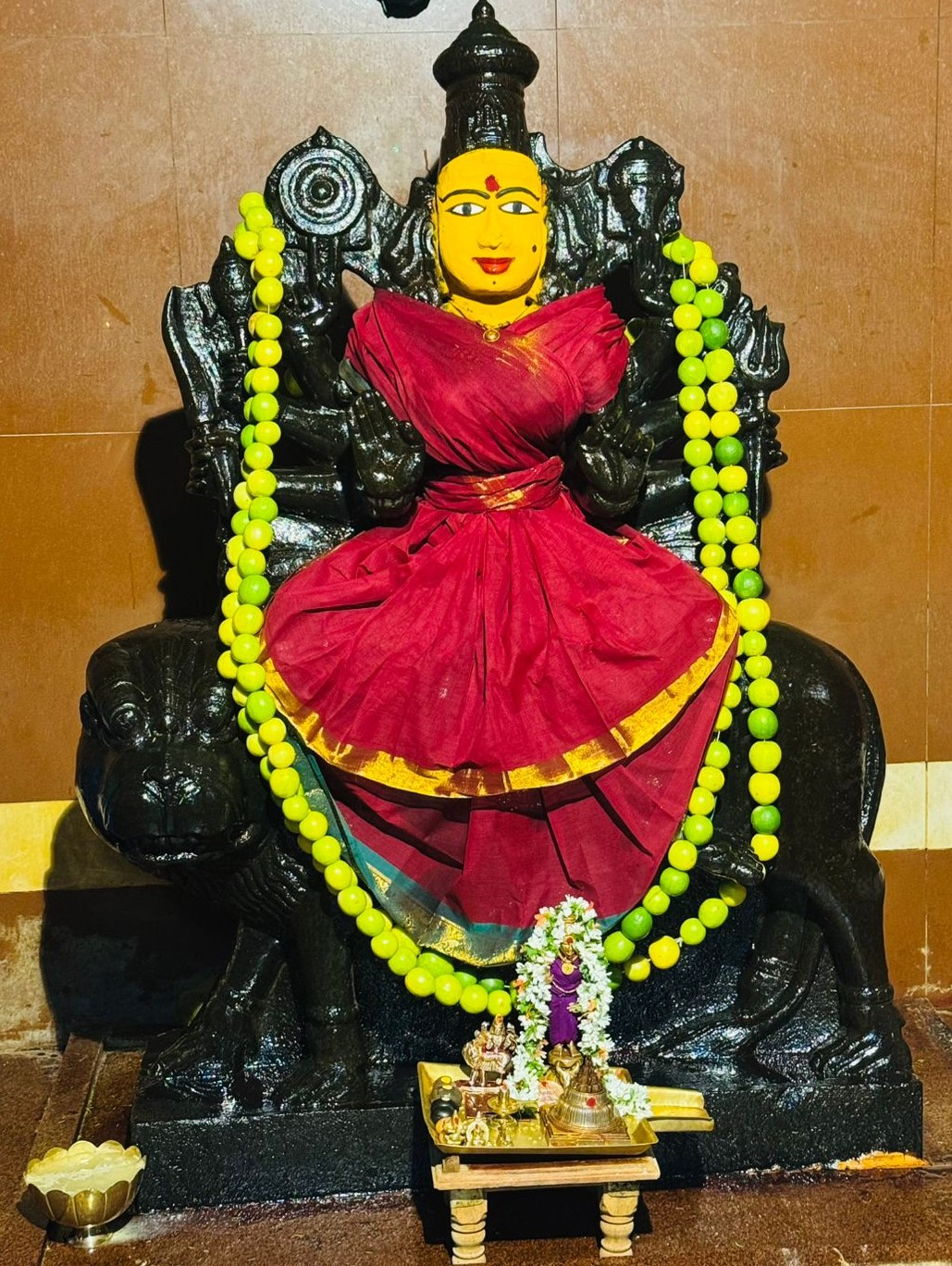
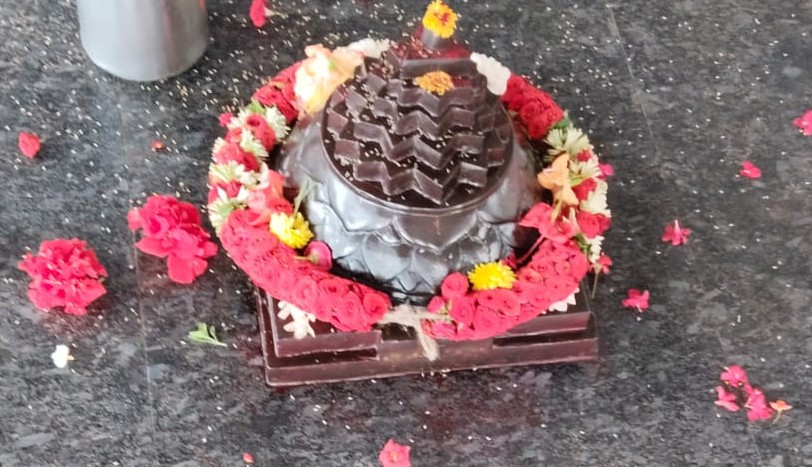
Those who go to behold a king first behold the attendant. Those who go for the darshan of a deity first behold the vehicle that serves that deity. Since the vehicle of Sri Vijaya Durga Devi is the lion, a pavilion has been built in front of the flag-staff, facing Amma, and within it a finely sculpted image of the lion — the king of beasts — has been consecrated. Having beheld the lion-king and coming a little forward, we behold the Sri Chakra pedestal, consecrated according to scripture by Vedic scholars. It is believed that Adi Shankaracharya, the World-Teacher, consecrated this Sri Chakra at the Shakti Peethas where the World-Mother manifested (in famous holy places such as Kanchi). Such a renowned Sri Chakra Meru has been consecrated here, suited for worship.
Moving four steps forward from there, Amma's offering-box (Hundi) comes into view. This Hundi has been crafted beautifully in the ancient style, shaped like a chest, with silver images of Amma fixed on all four sides and glass finely inlaid over those images. Devotees who come to the temple offer their pledged sums and fitting gifts into this Hundi. Crossing the first gateway and going forward from there, the devotees proceed in two rows — all the women on one side and all the men on the other — in orderly fashion within the bounds of the elegantly arranged steel railings, and at the fourth doorway the darshan of Sri Vijaya Durga Amma takes place beautifully.
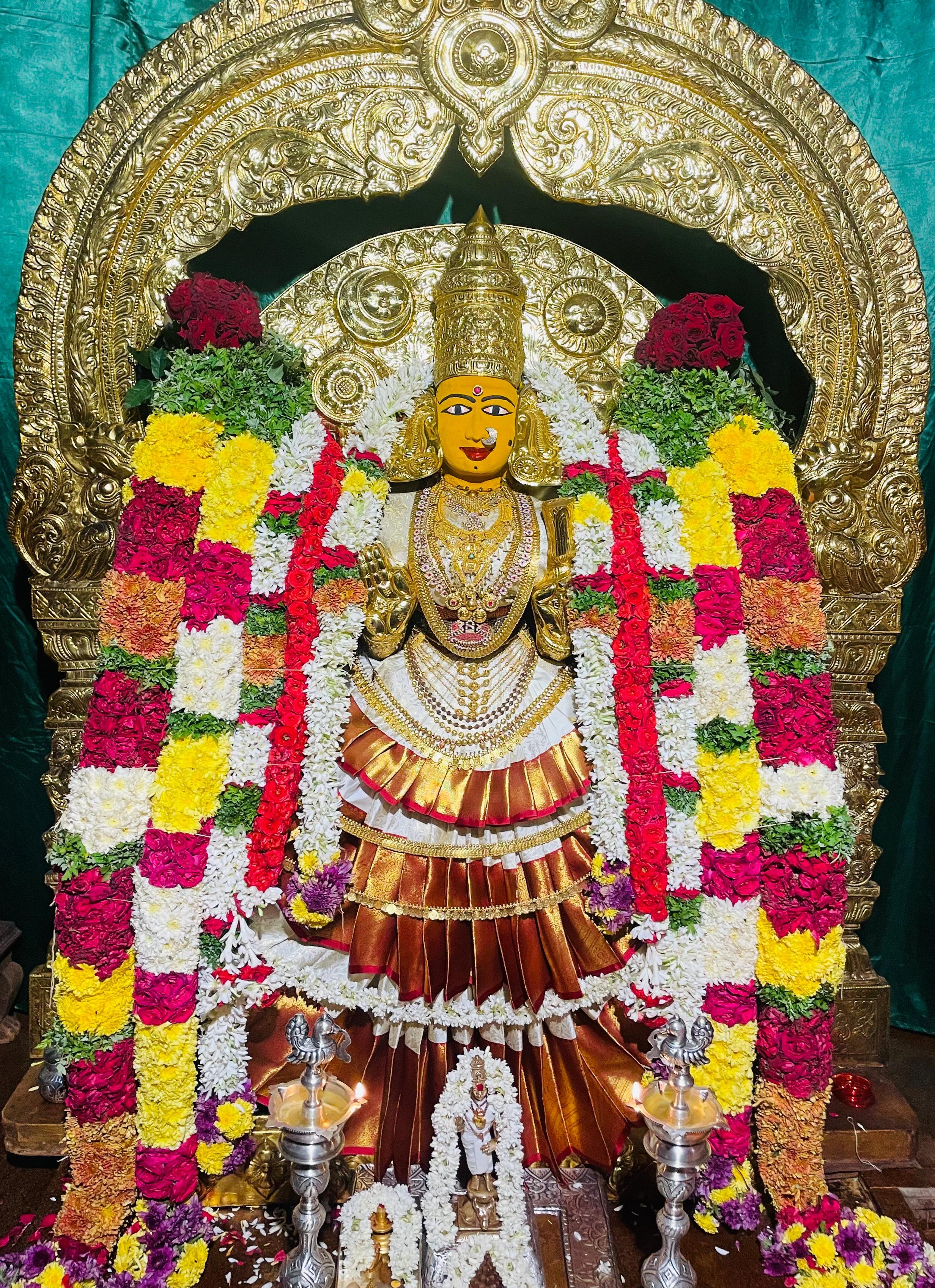
Amma appears holding the conch and the discus on either side, showing the hand of fearlessness (abhaya hasta) that is refuge for all the worlds, adorned with manifold ornaments and a fine silk saree, with a turmeric-golden — that is, fresh-green-hued — lotus-face and a large vermilion mark upon her brow. Among the nine gems, the ruby is said to be dear to Lord Surya. Such a glittering ruby has been set as the forehead-mark of Amma. To the devotees who behold it, it appears exactly like the orb of the sun. It also appears as Amma's third eye.
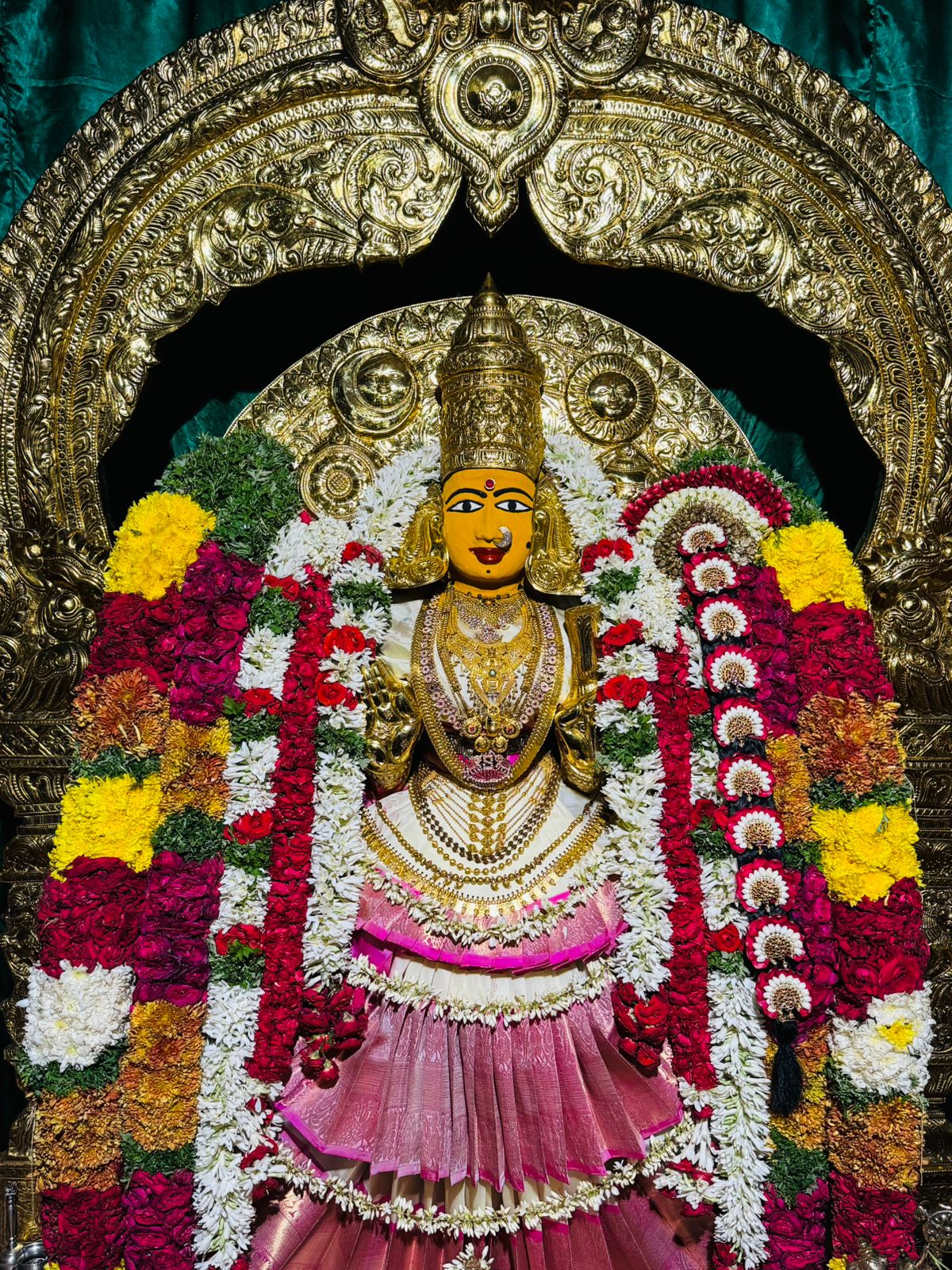
She appears with a fine nose-ring set with a diamond shining like a lamp, with an auspicious sacred thread (mangalasutra) gleaming radiantly, moving her lips in the shape of a tender crescent moon to spill forth a gentle smile, pouring the cool moonbeam-light of that smile upon the devotees — with eyes full of compassion and a serene countenance, the all-auspicious Amma grants us darshan as the very embodiment of peace.
This Vijaya Durgamma appears with the conch and the discus. The conch is the symbol of sound. Amma is the very embodiment of the Omkara, the Pranava sound; therefore she bears the conch. The discus is the symbol of light. Since Amma bears the sun, the moon and fire as her eyes, she is the embodiment of unbroken light; therefore she bears the discus. The powers that emanated from the faces of Hari and Hara took shape as one great power and incarnated as Sri Vijaya Durga Devi. That is why the Shaivites worship her as Ishwari and the Vaishnavites as Narayani.
Sloka: "O auspiciousness of all that is auspicious, O 'Shive', O fulfiller of every purpose, O refuge, O three-eyed Gauri, O 'Narayani' — salutations to you." Thus they pray.
After Amma's darshan, the priests bring to the devotees the camphor flame (harati) that has been waved before the deity. One should touch this sacred flame to one's eyes with the hands only once. It should not be touched again and again.
Likewise the priests offer the holy water (tirtham), giving it with the mantra: "The water from the feet of Sri Vijaya Durga Devi is purifying and auspicious — it removes untimely death, wards off all disease, and destroys all sins." Some who partake of that tirtham then wipe their hand over their head. To do so is not good. By drinking the tirtham from the palm, the hand becomes ritually impure (with saliva). With that impure hand one should not touch the head, which is the chief of all the limbs. At the crown of a person's head is the Brahmarandhra, which is called the seat of the chakra. If that part of the head is defiled, it becomes unfit to be bowed again at Amma's feet in obeisance.
For the convenience of the devotees, the interior of the shrine has been fitted with various fans and air-conditioning with cool-air machines. The whole temple has been beautifully finished with costly modern fittings and granite stones. While devotees go for darshan within the bounds built of steel railings, a passage has been set in the middle, between left and right, so that the devotees who have had darshan and are returning may go back conveniently and with great ease.
Devotees who have finished Amma's darshan should not at once turn around and walk away showing their back to the deity. Until they have crossed the main door of the sanctum, they should keep their face toward the deity, holding the form of the Goddess in their heart, and walk back slowly, stepping backward.
Having beheld Amma in this way and received her grace, the devotees who walk out should behold the idols of the Nine Planetary deities (Navagraha), consecrated in a beautiful pavilion in the northeastern part of the temple, and circumambulate them. Some people first behold the Navagrahas, circumambulate them, and then go back to behold the principal deity (Mulavirat). That is not the proper method; a fault accrues from it.
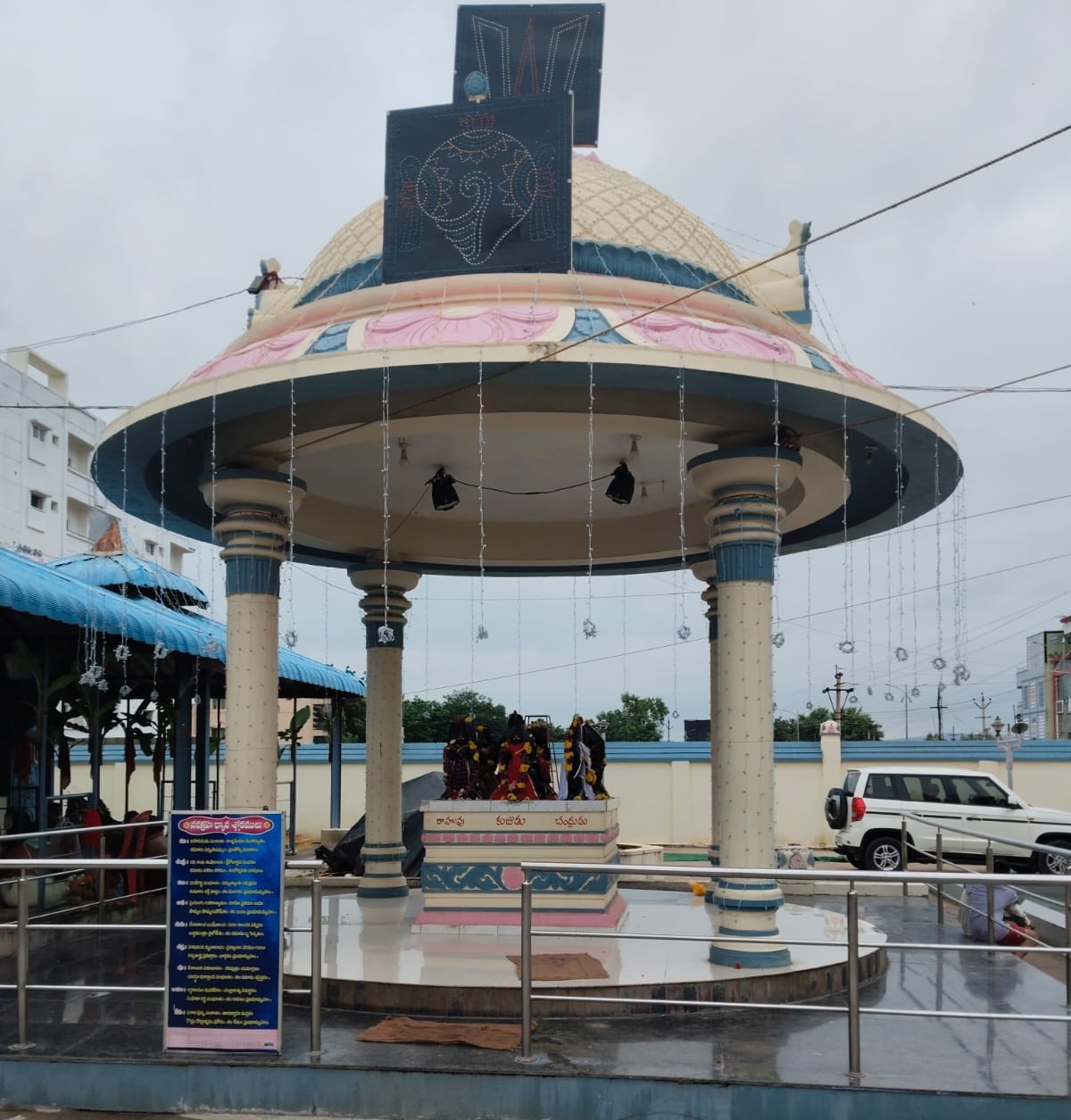
Only after first having darshan of Sri Durga Devi, the principal deity (Mulavirat), should one circumambulate the Navagrahas, offer obeisance, and depart. This is the correct method.
The tower (gopuram) of this Vijaya Durga temple, with its gold-plated finial (kalasha), has been built in accordance with the Agama scriptures, following the tradition of ancient gopuram sculptural art.
Standing at the temple's main gateway and looking, one has a clear darshan of Amma through the fourth doorway from there. There is a special significance here. Since Amma is the boon-giver who bestows the four-fold human goals (purusharthas) — Dharma, Artha, Kama and Moksha — the devotees, after passing through the three doorways of Dharma, Artha and Kama, receive Amma's darshan precisely at the fourth doorway, which is the doorway of Moksha (liberation).
After darshan, devotees going home should sit quietly for a few minutes, either in the temple pavilion or outside, remember Amma, and then leave. By doing so, the form of Amma is imprinted upon the mind and forever brings the mind a steady experience of bliss.
Free distribution of prasadam is carried out daily for the devotees who come for the darshan of the Goddess at the temple. Such service is most distinguished. Beside the temple, on the southern side, lodging houses have been built for pilgrims and for the temple priests. Among these rooms, a portion of air-conditioned rooms with modern amenities has also been built for distinguished guests. These tall apartments appear most beautiful to those who behold them.
In the rooms built beside the temple, whatever pooja materials are required are provided for devotees performing any kind of pooja. Devotees come here not only from the surrounding areas but from far away — from Nandyal, Kurnool, Proddatur, Chittoor, Anantapur and other neighbouring districts, from great cities such as Hyderabad and Bengaluru, and even from neighbouring states. Devotees coming from great distances can find everything here, without needing to bring their required pooja materials from home. Among the works undertaken for the convenience of devotees, this is a noteworthy one. In addition, various pictures of Amma, Sri Chakra yantras and idols finely made according to scripture in various metals, spiritual texts, and audio cassettes and CDs of devotional songs sung in praise of Amma are available.
The Temple's Founder
Now let us learn about a 'great sage'. This temple — dazzling with unbroken electric-lamp radiance, resplendent in a million hues, captivating the eyes — was shaped, beautiful in every part, into a great spiritual centre by one who spent his wealth, his effort and his time upon it. Through the building of this temple he turned the social order into a divine abode imbued with the contemplation of devotion, knowledge and dispassion — a great soul, a man of generosity, a spiritual…
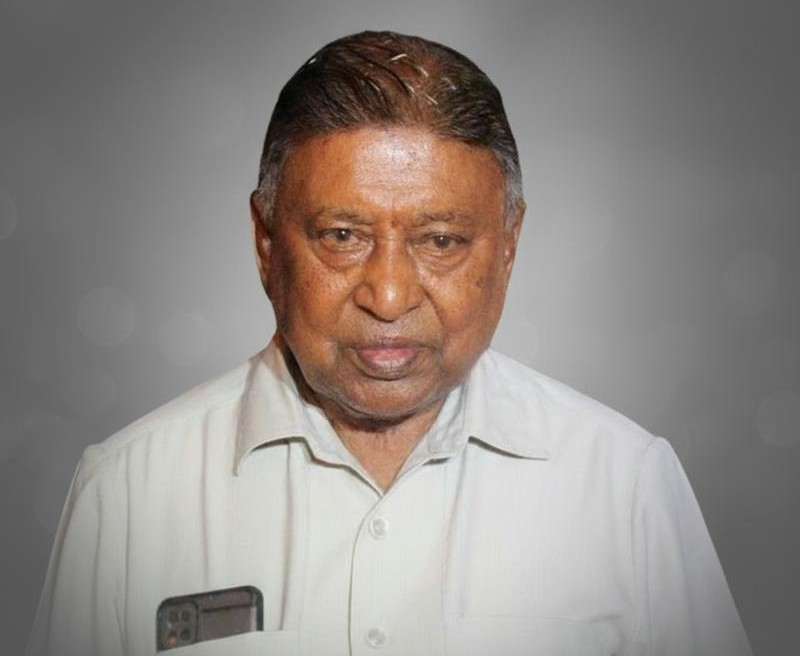
…a man of contemplation, honoured with the title "Dharmika Ratna" (Jewel of Righteousness). The great industrialist "Sri Sudha Mallikarjuna Rao" — without asking a single rupee in donation from anyone — resolved to pour a portion of the wealth he had earned by righteous means, through the grace of Mother Durga, into Amma's service alone; and he began this vast undertaking and brought it to fruition. Flourishing day by day, ever-festive like a fresh green festoon, the temple brings merit and the attainment of life's goals to the devotees who throng to it in crowds upon crowds.
As an ideal for all and a guide for generations to come, expecting no reward, with the spirit of total offering to the Divine (Brahmarpana), he established this temple as a great holy place.
Not only does he provide employment to the many workers laboring in his "Sri Durga Group of Companies" and "Sri Vijaya Durga Group of Companies", but he also gives the temple staff fitting amenities and wages, providing everyone a means of livelihood in a spirit of service. With the building of the Sri Durga temple, the people and all the devotees now call this Jewel of Righteousness, Sri Sudha Mallikarjuna Rao, by the fitting name 'Durga Mallikarjuna Rao'.
From the time he established the World-Mother here in Kadapa — as a harvest of merit for the multitude of devotees — and became the builder of the temple, the fame of this great soul has spread across continents and has won him a place written in letters of gold in history.
Besides this, lending support to many good works, providing free education facilities and jobs to the poor, and such other benevolent qualities are natural to his character.